LA Central Art Gallery
gallery.address
Kale Berria 5, 20001
Donostia / San Sebastián
gallery.openingHours
Friday: 5:30 PM - 9:00 PM | Saturday: 11:00 AM - 7:00 PM | Sunday: 11:00 AM - 14:00 PM
Website
lacentralartgallery.com ↗LA Central Art Gallery, a contemporary art reference in Gros.
gallery.exhibitions
Gipuzkoan
María Castilla
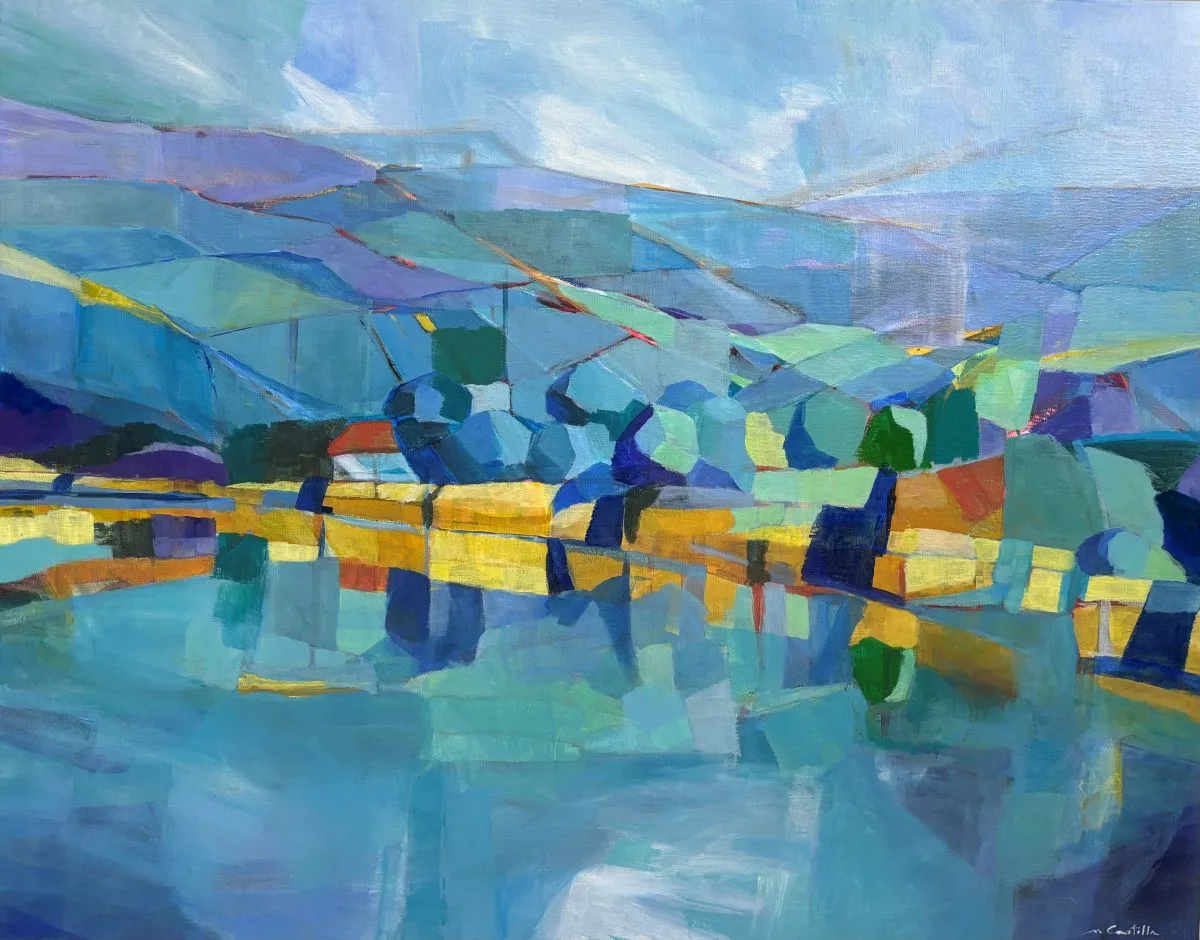
María Castilla’s painting belongs to a clearly recognizable tradition, that of landscape reinterpreted through the avant-gardes, yet she approaches it from a personal position that avoids both literalness and nostalgia. Her work does not describe nature: it reconstructs it. The guiding thread of her work is a synthesis between perception and structure. The artist takes the landscape, the mountains of Gipuzkoa and the constant presence of the sea, as a sensory experience. Yet she subjects it to a process of formal purification that clearly refers to Cubist languages. The fragmentation of the plane, the superimposition of chromatic fields and the simplification of volumes generate a constructed, non-naturalistic spatiality. However, unlike analytical Cubism, Castilla does not dissolve reality, but reorganizes it through an emotional lens. At this point, the expressionist dimension of her painting emerges. Colour does not function as a descriptive element, but as a structural and affective agent. Acid greens, saturated blues and broken tonal ranges take centre stage and shape the internal rhythm of the work, establishing tensions and balances that replace traditional perspective. The landscape ceases to be a place and becomes a state. It is significant that geometry does not impose itself as a rigid system, but rather as a flexible tool. The forms, although synthesized, retain an organic vibration that avoids constructive coldness. There is in her painting a constant negotiation between order and fluidity, between what has been learned through her theoretical grounding in art history and what has been lived. In her maritime scenes, light dissolves into broad planes that recall certain Post-Impressionist solutions, while in the interior landscapes the structure becomes more fragmented, almost tectonic. In both cases, the result is a painting that oscillates between contemplation and intellectual construction. María Castilla does not paint the Basque landscape: she translates it into her own language, where colour is the absolute protagonist and form is a vehicle. Her work reveals an artist who is aware of tradition but not subordinated to it; an artist capable of integrating historical references into a coherent pictorial practice, where nature is, above all, a pretext for thinking about painting.